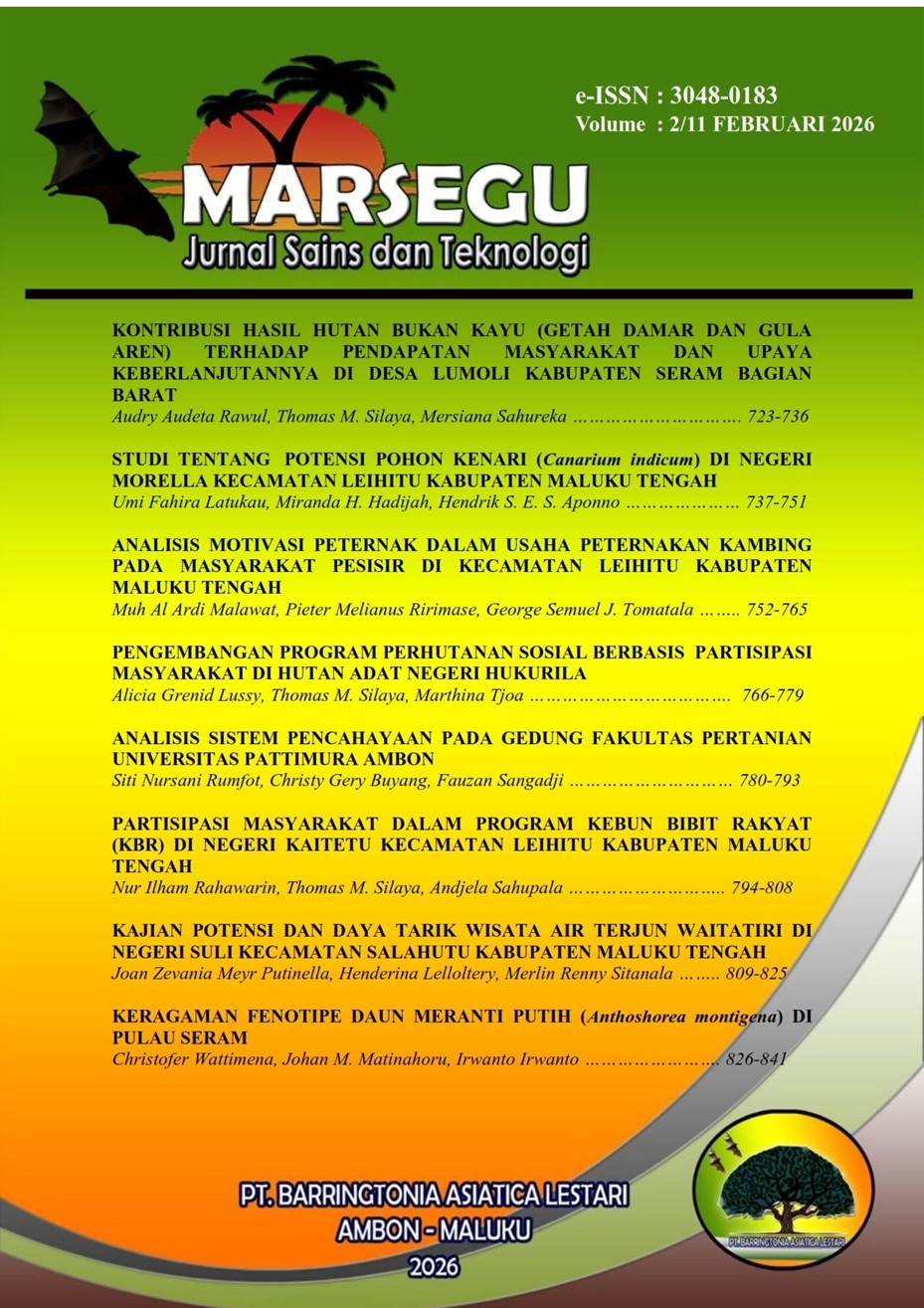
KERAGAMAN FENOTIPE TANAMAN KENARI (Canarium sp.) PADA KEBUN KOLEKSI DI DESA HATUSUA KECAMATAN KAIRATU KABUPATEN SERAM BAGIAN BARAT
DOI:
https://doi.org/10.69840/marsegu/3.1.2026.16-46Keywords:
Canarium sp., phenotypic diversity, provenance, environmental factors, MalukuAbstract
This study aims to analyze the phenotypic diversity of canary plants (Canarium sp.) from three provenances, namely Ambon, Saparua, and Seram, and to observe the relationship between environmental factors and the growth of canary plants in the Canary Collection Garden owned by the Maluku Provincial Forestry Service, located in Hatusua Village, Kairatu District, West Seram Regency. This study used a descriptive method and a completely randomized design (CRD) with ANOVA analysis, multiple regression, and cluster analysis to evaluate phenotypic characters (leaves, stems, fruits/seeds) and environmental factors (light, temperature, humidity, soil pH, fertility, and soil moisture). The results showed that there were significant differences in leaf phenotypic characters (area, length, width), and most of the differences in stem and fruit/seed size were caused by environmental factors. Seram provenance showed greater leaf area and seed weight than Ambon and Saparua. However, the ANOVA results showed that only leaf area showed a significant effect of provenance treatment. Meanwhile, the relationship between vegetative growth (number of branches, stem diameter, and branch-free height) and environmental factors showed varying correlations, depending on the provenance. Cluster analysis grouped the Ambon and Saparua provenances into a phenotypically similar group, while Seram formed a separate cluster.
Downloads
References
Asria Alim, Muhammad Nur , Salam, Laswi Irmayanti, 2023. Potensi Pohon Kenari (Canarium sp.) di Desa Talapaon Kecamatan Makian Barat Kabupaten Halmahera Selatan Provinsi Maluku Utara
Bakarbessy Isak 2019. Study Pertumbuhan Tanaman Kenari (Canarium Ambonensis) Di Demplot Sumber Benih Pada Desa Hatusua Kecamatan Kairatu Kabupaten Seram Bagian Barat, Skripsi.
Djarkasi.,Dkk.2007.Sifat Fisik dan Kimia Minyak Kenari. Jurnal AGRITECH Volume 27,No. 4 Desember 2007. Diakses pada tanggal 13 Januari 2022 pada https://jurnal.ugm.ac.id/agritech/article/dow nload/9857/7420
Dodo.2005. Pengaruh Media Semai Dalam Peningkatan Produksi Bibit Kenari. Pusat konservasi Tumbuhan Kebun Raya – Lipi. Bogor
Evans, B. 1994. Overview of Resource Potential for Indigenous Nut Production in South Pacific Indigenous Nuts. edited by Steven, M.L., Bourke, R.m., and Evans, B.R. Proceedings of a workshop 31 October – 4 November, Vanuatu. Pp. 10-35.
I Made Yuliara, 2016. Regresi Linear Berganda. Universitas Udayana Bali.
Jupranto, 2004. Analisis Multivariat : Arti dan Interpretasi. Penerbit Rineka Cipta,Jakarta. Teknik Analisis Dalam Penelitian Percobaan, Penerbit Tarsito Bandung, Bandung.
Kakuda, Y., Jahaniaval F., Marcone M.F., Montevirgen L., Montevirgen Q. dan Umali J. 2000. Characterization of Pili Nut (Canarium ovatum) Oil: Fatty Acid and Triacylglycerol Composition and Physicochemical Properties. Journal of American Oil Chemist Society 77: 991-996.
Komul Y.D, Febian F. Tetelay, 2023. Uji Keberhasilan Tumbuh Dua Provenans Kanari (Canarium amboinensis) Pada Awal Penanaman. Jurnal Sylva Scienteae Vol. 6 , Hal. 140-145.
Kennedy, J and W.Clarke, 2004. Cultivated Landscapes of the Southwest Pasific. Resource Management in Asia-Pasific, Canberra.
Larcher, W. 1975. Physiological Plant Ecologi. Springer Verlag Berlin Heidelberg. New York.
Majapahit Julfitra 2016. Study Perkembangan Tanaman Kenari (Canarium Ambonensis) Di Demplot Sumber Benih Pada Desa Hatusua Kecamatan Kairatu Kabupaten Seram Bagian Barat (Renumerasi IV). Skripsi.
Matinahoru Johan M. 2008. Pemuliaan Pohon.. Penerbit Fakultas Pertanian Unpatti. ISBN 978-979-18093-7-5
Patalala R. 2021. Pertumbuhan Dan Perkembangan Tanaman Kenari (Canarium Ambonensis) Renumerasi Viii Di Demplot Sumber Benih Desa Hatusua Kecamatan Kairatu Kabupaten Seram Bagian Barat. Jurusan Kehutanan.Universitas Pattimura. Skripsi.
Rahman Z. 2011. Prospek Usaha Tani Kenari Melalui Pendekatan Agribisnis diKecamatan Pulau Makian Kabupaten Halmahera Selatan (Tesis) Makasar Universitas Hasanudin
Siahaya Ludia, C.M.A Wattimena dan H.A.J Jacobs, 2021. Pertumbuhan Tanaman Kenari (Canarium Ambonensis) Di Demplot Sumber Benih Hatusua Kabupaten Seram Bagian Barat Jounal Hutan Pulau-Pulau Kecil, Jurnal Ilmu-Ilmu Kehutanan dan Pertanian. Volume 4 No. 1. Ambon
Sigit Nugroho, 2008. Dasar-Dasar Rancangan Percobaan. Penerbit UNIB Press. ISBN : 978-979-9431-34-9; 256 hal.
Slack Jonathan M.W, 2018. The Science of Stem Cell. John Wiley & Sons, Inc. ISBN:9781119235156|OnlineISBN:9781119235293DOI:10.1002/9781119235293
Sui C.H, K.M Lau,Y.N Takayabu, and D.A Short,1997. Diurnal Variations in Tropical Oceanic Cumulus Convection.
Theodore T. Kozlowski; Stephen G. Pallardy, 1995. Physiology of Woody Plants. Academic Press, New York. Second Edition.
Thomson, L.A.J. dan Evans, B. 2004. Canarium indicum var. indicum and C. barveyi (canarium nut). Species Profiles for Pacific Island Agroforestry. Version 1.1. http://www.traditionaltree.org [5 Agustus 2005]
Yen, D.E. 1994. Melanesian Arboriculture: Historical Perspectives with Emphasis on Genus Canarium. in South Pacific Indigenous Nuts, edited by Steven, M.L., Bourke, R.m., and Evans, B.R. Proceedings of a workshop 31 October – 4 November, Vanuatu. Pp. 36-44.
Downloads
Published
Issue
Section
License
Copyright (c) 2026 Elva Dasilvia Rianekuay, Johan M. Matinahoru, Andjela Sahupala (Author)

This work is licensed under a Creative Commons Attribution-ShareAlike 4.0 International License.